circa 1905–1910
Adelaide Herrmann
Hindoo Magic
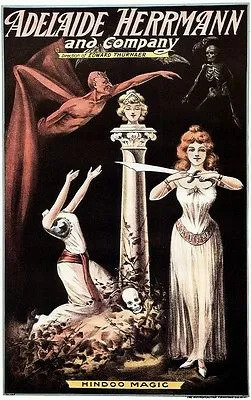
A demon flies, a skeleton watches, and Adelaide Herrmann holds the sword. More unusually for the period, the woman is plainly in charge.
 Find a show
circa 1905–1910
Hindoo Magic
A demon flies, a skeleton watches, and Adelaide Herrmann holds the sword. More unusually for the period, the woman is plainly in charge.
Watch the poster story
Narrated by Dominic · Poe’s Magic Theatre at the Lord Baltimore Hotel
Watch on YouTube · Timestamps and references01
Adelaide Herrmann stands in white against a dark stage, holding a sword horizontally across her body. Around her, a red-winged demon, a skeleton, a skull, an inverted figure, and a disembodied head displayed on a pedestal create a catalogue of menace and marvel. The arrangement is theatrical rather than realistic, compressing an entire evening into one impossible scene.
The phrase ‘Hindoo Magic’ uses an outdated spelling and reflects the period’s Orientalism. Western producers routinely borrowed distorted versions of South Asian religion and culture as instant signals of ancient mystery. That reduction was harmful, and Poe’s Magic Theatre does not endorse it. The poster remains valuable because it shows both Herrmann’s unusual prominence and the prejudiced advertising conventions through which that prominence was sold.
02
Adelaide Herrmann was born in London in 1853. After performing with her husband, Alexander Herrmann, she continued the company following his death and built a major career of her own. She became known as the Queen of Magic and was among the most important women in the history of stage illusion.
Her image here is not tucked into a corner as an assistant. She is the attraction. That distinction was far from ordinary, and she kept earning it in theatres for decades.
“Adelaide Herrmann and Company”
Welcome to the Magic Poster Tour at Poe’s Magic Theatre, inside the historic Lord Baltimore Hotel.
This stop features Adelaide Herrmann and Company, a circa 1905–1910 piece billed as “Hindoo Magic.”
Adelaide Herrmann stands in white against a dark stage, holding a sword horizontally across her body. Around her, a red-winged demon, a skeleton, a skull, an inverted figure, and a disembodied head displayed on a pedestal create a catalogue of menace and marvel. The arrangement is theatrical rather than realistic, compressing an entire evening into one impossible scene.
The phrase ‘Hindoo Magic’ uses an outdated spelling and reflects the period’s Orientalism. Western producers routinely borrowed distorted versions of South Asian religion and culture as instant signals of ancient mystery. That reduction was harmful, and Poe’s Magic Theatre does not endorse it. The poster remains valuable because it shows both Herrmann’s unusual prominence and the prejudiced advertising conventions through which that prominence was sold.
Adelaide Herrmann was born in London in 1853. After performing with her husband, Alexander Herrmann, she continued the company following his death and built a major career of her own. She became known as the Queen of Magic and was among the most important women in the history of stage illusion.
Her image here is not tucked into a corner as an assistant. She is the attraction. That distinction was far from ordinary, and she kept earning it in theatres for decades.