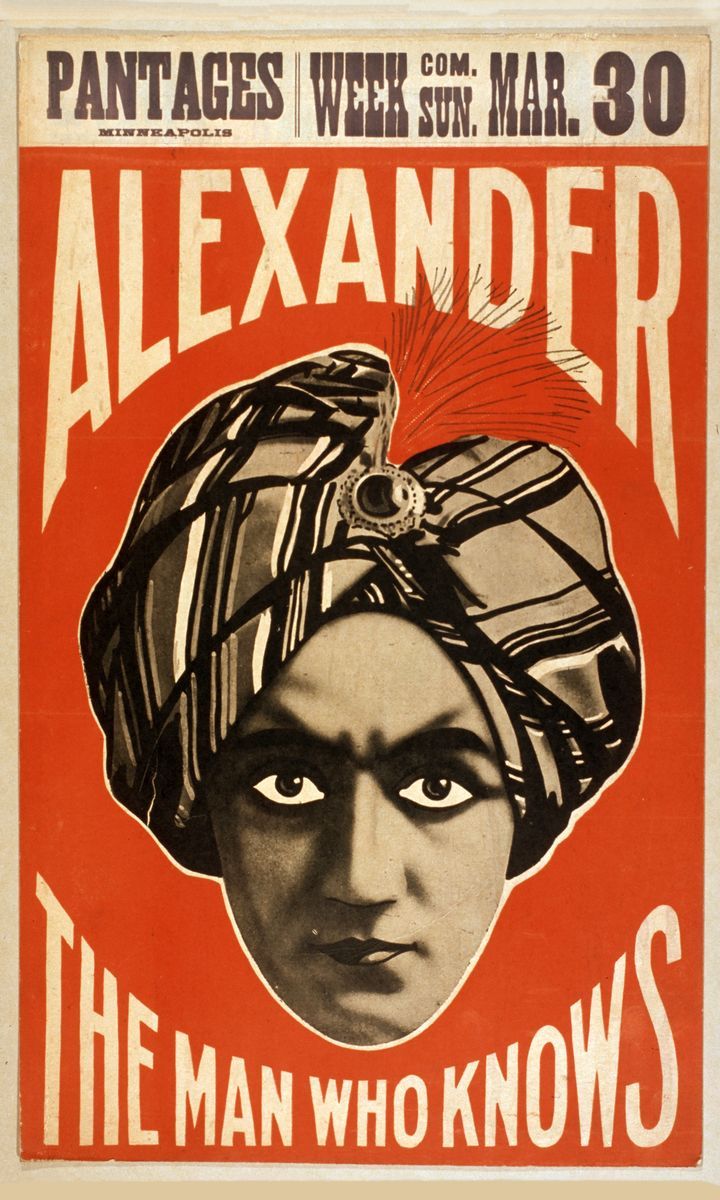
circa 1915–1920
Alexander
The Man Who Knows
No tricks are shown. No stage is shown. Just one enormous stare, which appears to know what you did last Thursday.
 Find a show
circa 1915–1920
The Man Who Knows
No tricks are shown. No stage is shown. Just one enormous stare, which appears to know what you did last Thursday.
Watch the poster story
Narrated by Dominic · Poe’s Magic Theatre at the Lord Baltimore Hotel
Watch on YouTube · Timestamps and references01
This severe three-color design reduces the magician to a graphic emblem. Cream paper, black shadows, and a hot red field make Alexander’s turbaned face visible from across a street. His name rises diagonally, while the eyes sit almost exactly where a viewer cannot avoid them.
The poster borrows the visual language of fortune-telling and an imagined ‘East’ to manufacture supernatural authority. That Orientalist costume is not a neutral decoration. It turns cultures into shorthand for secrecy and irrational mystery, a practice rooted in racist Western stereotypes. Poe’s Magic Theatre does not endorse that idea, even while preserving the design as evidence of how mentalists were sold to the public.
02
Claude Alexander Conlin, born in 1880, became one of the most successful theatrical mind readers of the early twentieth century. His stage character, Alexander, answered written questions and presented apparent feats of clairvoyance under the billing ‘The Man Who Knows.’
His publicity was often more durable than his biography, which is crowded with reinvention, exaggeration, legal trouble, and stories polished by Alexander himself. The poster wisely avoids details. It gives us the only claim that mattered at the box office: he knows.
“The Man Who Knows”
Welcome to the Magic Poster Tour at Poe’s Magic Theatre, inside the historic Lord Baltimore Hotel.
This stop features Alexander, The Man Who Knows, a circa 1915–1920 piece billed as “The Man Who Knows.”
This severe three-color design reduces the magician to a graphic emblem. Cream paper, black shadows, and a hot red field make Alexander’s turbaned face visible from across a street. His name rises diagonally, while the eyes sit almost exactly where a viewer cannot avoid them.
The poster borrows the visual language of fortune-telling and an imagined ‘East’ to manufacture supernatural authority. That Orientalist costume is not a neutral decoration. It turns cultures into shorthand for secrecy and irrational mystery, a practice rooted in racist Western stereotypes. Poe’s Magic Theatre does not endorse that idea, even while preserving the design as evidence of how mentalists were sold to the public.
Claude Alexander Conlin, born in 1880, became one of the most successful theatrical mind readers of the early twentieth century. His stage character, Alexander, answered written questions and presented apparent feats of clairvoyance under the billing ‘The Man Who Knows.’
His publicity was often more durable than his biography, which is crowded with reinvention, exaggeration, legal trouble, and stories polished by Alexander himself. The poster wisely avoids details. It gives us the only claim that mattered at the box office: he knows.