nineteenth-century
Professor Anderson
World of Magic
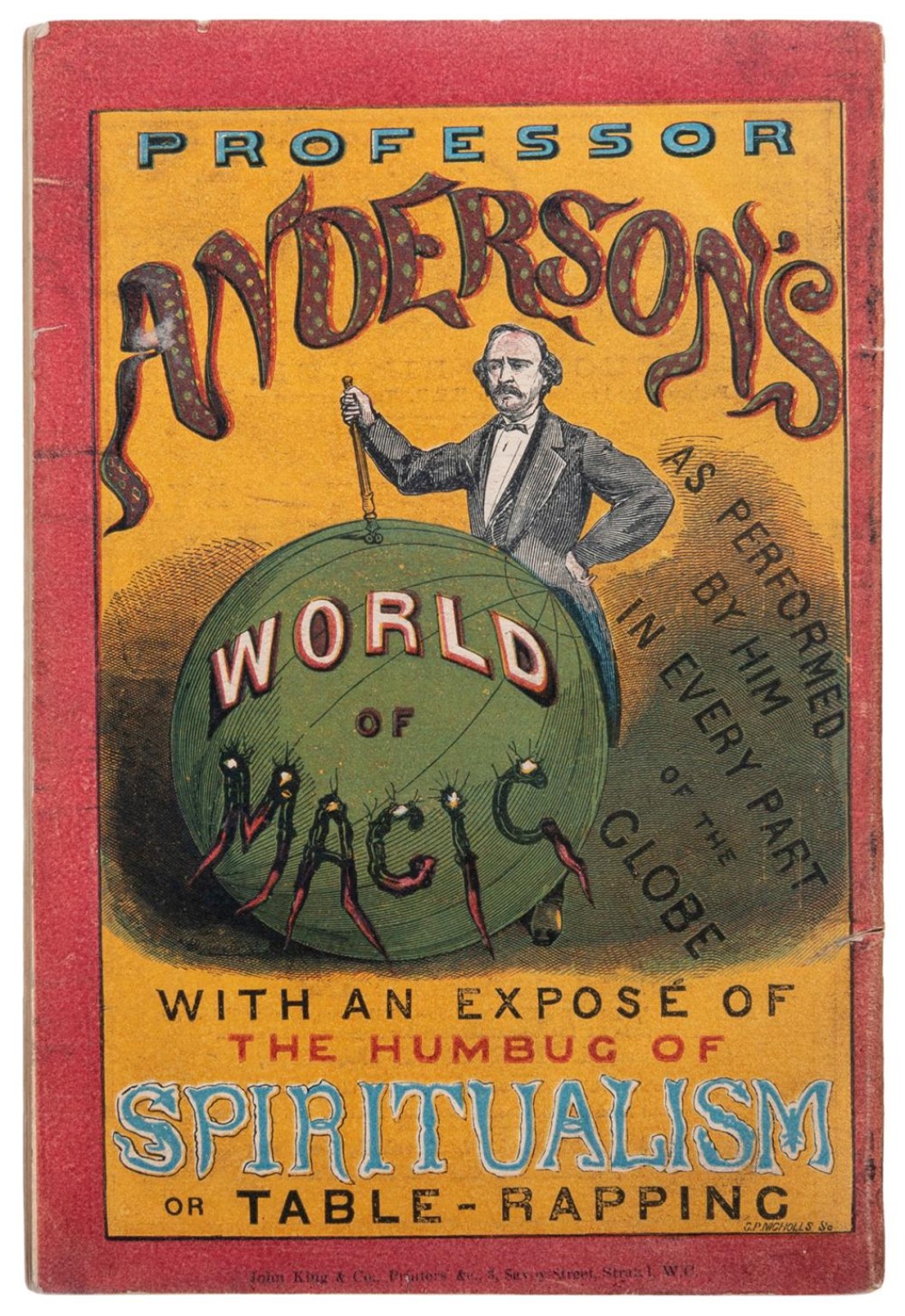
Anderson stands behind the globe as though he has booked the entire planet. The lettering seems prepared to back him up.
 Find a show
nineteenth-century
World of Magic
Anderson stands behind the globe as though he has booked the entire planet. The lettering seems prepared to back him up.
Watch the poster story
Narrated by Dominic · Poe’s Magic Theatre at the Lord Baltimore Hotel
Watch on YouTube · Timestamps and references01
The magician's name curves across an orange field, above a portrait of Anderson holding his wand behind an enormous green globe. Little fantastic figures twist into the letters of Magic. A red border and blue lettering add still more color. It is Victorian pictorial show advertising at full volume: the portrait lends authority, the globe promises international fame, and even the alphabet has been persuaded to perform.
The design carries the printed engraving credit G. P. Nicholls, followed by the abbreviation Sc., and names John King and Company as printers. Nicholls's initials should not be mistaken for a securely identified full name, nor does an engraving credit establish who planned the complete composition. The exact issue date and original printing process have not been established. Its fine hatched line-work and elaborate lettering belong to the visual vocabulary of nineteenth-century illustrated publicity.
At the bottom, Anderson advertises an exposure of Spiritualism and table-rapping. The contrast is the attraction: a man selling a World of Magic also promises to show how other people's supposed wonders are produced. The public argument over spirit communication becomes another reason to buy a ticket.
02
John Henry Anderson, born in Scotland in 1814, became famous as the Great Wizard of the North. He combined theatrical conjuring with a formidable appetite for publicity. A contemporary review of his World of Magic at London's St James's Hall in 1864 describes productions from a scrapbook, an inexhaustible bottle, and performances involving his daughter. The family enterprise was larger than the commanding figure at the center of the advertisement.
There is a direct Baltimore connection in the surviving paper record. In 1853, Anderson published a collection of letters to the editors of the Baltimore Sun challenging spirit-rapping, together with a writing medium's reply. That documents a debate reaching Baltimore's readers; it does not, by itself, establish a local stage engagement. The arguments over wonder, evidence, and showmanship were already busy here long before this theatre opened.
“World of Magic”
Welcome to the Magic Poster Tour at Poe’s Magic Theatre, inside the historic Lord Baltimore Hotel.
This stop features Professor Anderson's World of Magic, a nineteenth-century piece billed as “World of Magic.”
The magician's name curves across an orange field, above a portrait of Anderson holding his wand behind an enormous green globe. Little fantastic figures twist into the letters of Magic. A red border and blue lettering add still more color. It is Victorian pictorial show advertising at full volume: the portrait lends authority, the globe promises international fame, and even the alphabet has been persuaded to perform.
The design carries the printed engraving credit G. P. Nicholls, followed by the abbreviation Sc., and names John King and Company as printers. Nicholls's initials should not be mistaken for a securely identified full name, nor does an engraving credit establish who planned the complete composition. The exact issue date and original printing process have not been established. Its fine hatched line-work and elaborate lettering belong to the visual vocabulary of nineteenth-century illustrated publicity.
At the bottom, Anderson advertises an exposure of Spiritualism and table-rapping. The contrast is the attraction: a man selling a World of Magic also promises to show how other people's supposed wonders are produced. The public argument over spirit communication becomes another reason to buy a ticket.
John Henry Anderson, born in Scotland in 1814, became famous as the Great Wizard of the North. He combined theatrical conjuring with a formidable appetite for publicity. A contemporary review of his World of Magic at London's St James's Hall in 1864 describes productions from a scrapbook, an inexhaustible bottle, and performances involving his daughter. The family enterprise was larger than the commanding figure at the center of the advertisement.
There is a direct Baltimore connection in the surviving paper record. In 1853, Anderson published a collection of letters to the editors of the Baltimore Sun challenging spirit-rapping, together with a writing medium's reply. That documents a debate reaching Baltimore's readers; it does not, by itself, establish a local stage engagement. The arguments over wonder, evidence, and showmanship were already busy here long before this theatre opened.