book first published in 1925
Black Herman
Secrets of Magic, Mystery and Legerdemain
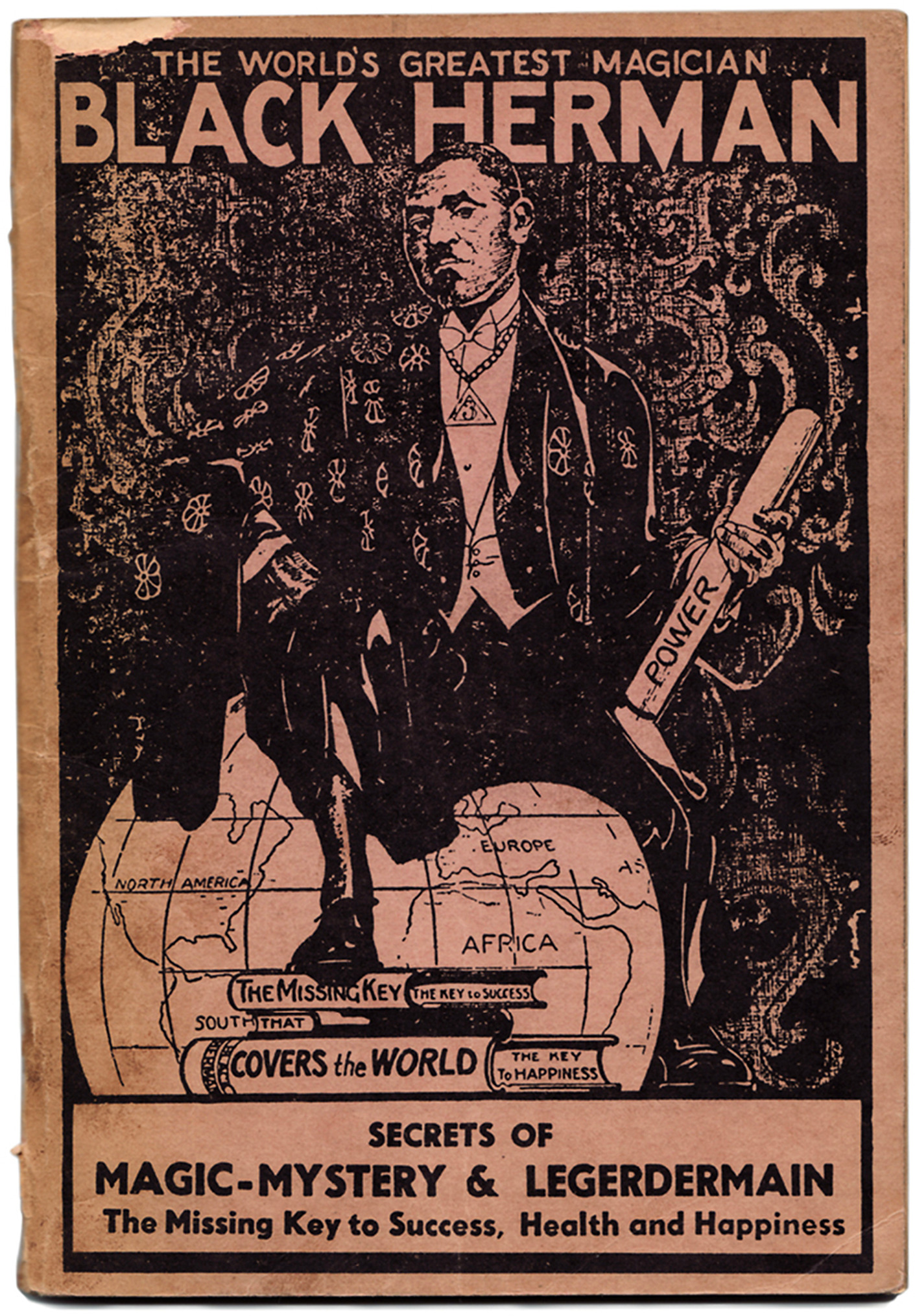
Black Herman stands astride the world while holding a key marked Power. Subtlety has taken the afternoon off.
 Find a show
book first published in 1925
Secrets of Magic, Mystery and Legerdemain
Black Herman stands astride the world while holding a key marked Power. Subtlety has taken the afternoon off.
Watch the poster story
Narrated by Dominic · Poe’s Magic Theatre at the Lord Baltimore Hotel
Watch on YouTube · Timestamps and references01
This is the cover of Black Herman’s Secrets of Magic, Mystery and Legerdemain rather than a conventional theatre poster. Printed in black on warm brown paper, it places the formally dressed magician above a globe marked North America, Europe, and Africa. A large key labeled Power rests in his hand, while books below promise success, health, and happiness.
The dense border contains symbols, figures, and suggestions of hidden knowledge. The design mixes a mail-order book advertisement with the visual authority of a stage poster. Black Herman is not shown performing a trick. He is presented as the possessor of knowledge that crosses continents, controls fortune, and can be purchased between covers.
The composition also reflects the era’s fascination with Africa as a source of mystery. Black Herman used African identity strategically in a segregated entertainment business, building pride and authority for Black audiences while also working within exotic stereotypes already familiar to American advertising. That tension belongs in the history. It should not be polished away.
The displayed image reproduces the cover of Black Herman’s book. The original work was first published in 1925 and was reissued in later editions.
02
Black Herman was the stage name of Benjamin Rucker, born in Virginia near the end of the nineteenth century. After learning from the traveling performer Prince Herman, he developed a career combining stage magic, medicine-show salesmanship, mental feats, hoodoo traditions, and an extraordinary talent for publicity.
He became the most prominent Black magician of his era, performing especially for African American audiences during segregation. His celebrated attractions included escapes, levitation, and a buried-alive presentation in which he was exhumed and returned to the theatre several days later. The act turned resurrection into advance publicity, which is difficult to improve upon.
His book combined simple magic instruction, autobiographical storytelling, astrology, lucky numbers, spiritual material, and advice about success. The edition history is complicated, and parts of the text may have been shaped by other writers, but the book extended Black Herman’s stage identity into homes and communities far beyond a single performance.
Black Herman died in 1934. Because audiences knew his buried-alive act, some refused to believe the death was genuine. His body was displayed publicly before burial, giving a grim final chapter to a career built upon the promise that death itself might only be an intermission.
“The Missing Key to Success, Health and Happiness”
Welcome to the Magic Poster Tour at Poe’s Magic Theatre, inside the historic Lord Baltimore Hotel.
This stop features Black Herman, a book first published in 1925 piece billed as “Secrets of Magic, Mystery and Legerdemain.”
This is the cover of Black Herman’s Secrets of Magic, Mystery and Legerdemain rather than a conventional theatre poster. Printed in black on warm brown paper, it places the formally dressed magician above a globe marked North America, Europe, and Africa. A large key labeled Power rests in his hand, while books below promise success, health, and happiness.
The dense border contains symbols, figures, and suggestions of hidden knowledge. The design mixes a mail-order book advertisement with the visual authority of a stage poster. Black Herman is not shown performing a trick. He is presented as the possessor of knowledge that crosses continents, controls fortune, and can be purchased between covers.
The composition also reflects the era’s fascination with Africa as a source of mystery. Black Herman used African identity strategically in a segregated entertainment business, building pride and authority for Black audiences while also working within exotic stereotypes already familiar to American advertising. That tension belongs in the history. It should not be polished away.
The displayed image reproduces the cover of Black Herman’s book. The original work was first published in 1925 and was reissued in later editions.
Black Herman was the stage name of Benjamin Rucker, born in Virginia near the end of the nineteenth century. After learning from the traveling performer Prince Herman, he developed a career combining stage magic, medicine-show salesmanship, mental feats, hoodoo traditions, and an extraordinary talent for publicity.
He became the most prominent Black magician of his era, performing especially for African American audiences during segregation. His celebrated attractions included escapes, levitation, and a buried-alive presentation in which he was exhumed and returned to the theatre several days later. The act turned resurrection into advance publicity, which is difficult to improve upon.
His book combined simple magic instruction, autobiographical storytelling, astrology, lucky numbers, spiritual material, and advice about success. The edition history is complicated, and parts of the text may have been shaped by other writers, but the book extended Black Herman’s stage identity into homes and communities far beyond a single performance.
Black Herman died in 1934. Because audiences knew his buried-alive act, some refused to believe the death was genuine. His body was displayed publicly before burial, giving a grim final chapter to a career built upon the promise that death itself might only be an intermission.