circa 1926
Carter
Carter Beats the Devil
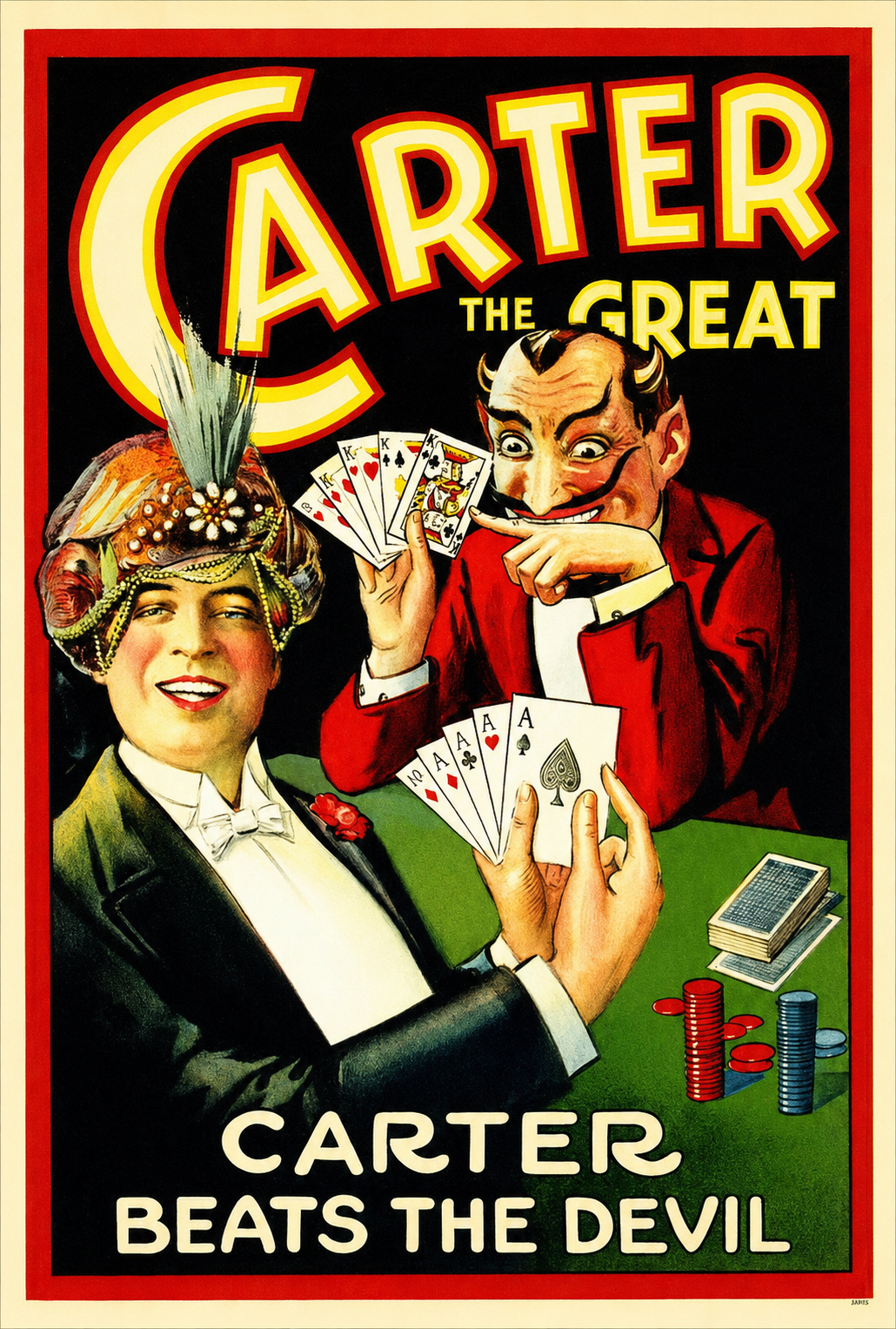
Carter has drawn four aces. The Devil looks annoyed. One assumes house rules were discussed beforehand.
 Find a show
circa 1926
Carter Beats the Devil
Carter has drawn four aces. The Devil looks annoyed. One assumes house rules were discussed beforehand.
Watch the poster story
Narrated by Dominic · Poe’s Magic Theatre at the Lord Baltimore Hotel
Watch on YouTube · Timestamps and references01
This famous design uses a blazing red field, black shadows, and yellow lettering to stage a compact duel. Carter sits at a green card table displaying his hand while a horned Devil leans in with cards of his own. A deck and stacks of red and blue chips complete the wager.
The poster reads instantly from a distance. Its limited palette, enormous curved title, and theatrical faces make it closer to a pulp cover than a documentary scene. It does not explain an illusion. It creates a character who can outwit evil itself and still make the evening train.
02
Charles Joseph Carter, known as Carter the Great, was an American touring illusionist whose company traveled extensively across the world. His large show and spectacular advertising helped make him one of the recognizable magical figures of the early twentieth century.
The Devil was a recurring companion in magic advertising, useful because he implied forbidden powers without requiring much copy. Here he is less a source of terror than Carter’s disgruntled opponent.
“Carter Beats the Devil”
Welcome to the Magic Poster Tour at Poe’s Magic Theatre, inside the historic Lord Baltimore Hotel.
This stop features Carter Beats the Devil, a circa 1926 piece billed as “Carter Beats the Devil.”
This famous design uses a blazing red field, black shadows, and yellow lettering to stage a compact duel. Carter sits at a green card table displaying his hand while a horned Devil leans in with cards of his own. A deck and stacks of red and blue chips complete the wager.
The poster reads instantly from a distance. Its limited palette, enormous curved title, and theatrical faces make it closer to a pulp cover than a documentary scene. It does not explain an illusion. It creates a character who can outwit evil itself and still make the evening train.
Charles Joseph Carter, known as Carter the Great, was an American touring illusionist whose company traveled extensively across the world. His large show and spectacular advertising helped make him one of the recognizable magical figures of the early twentieth century.
The Devil was a recurring companion in magic advertising, useful because he implied forbidden powers without requiring much copy. Here he is less a source of terror than Carter’s disgruntled opponent.