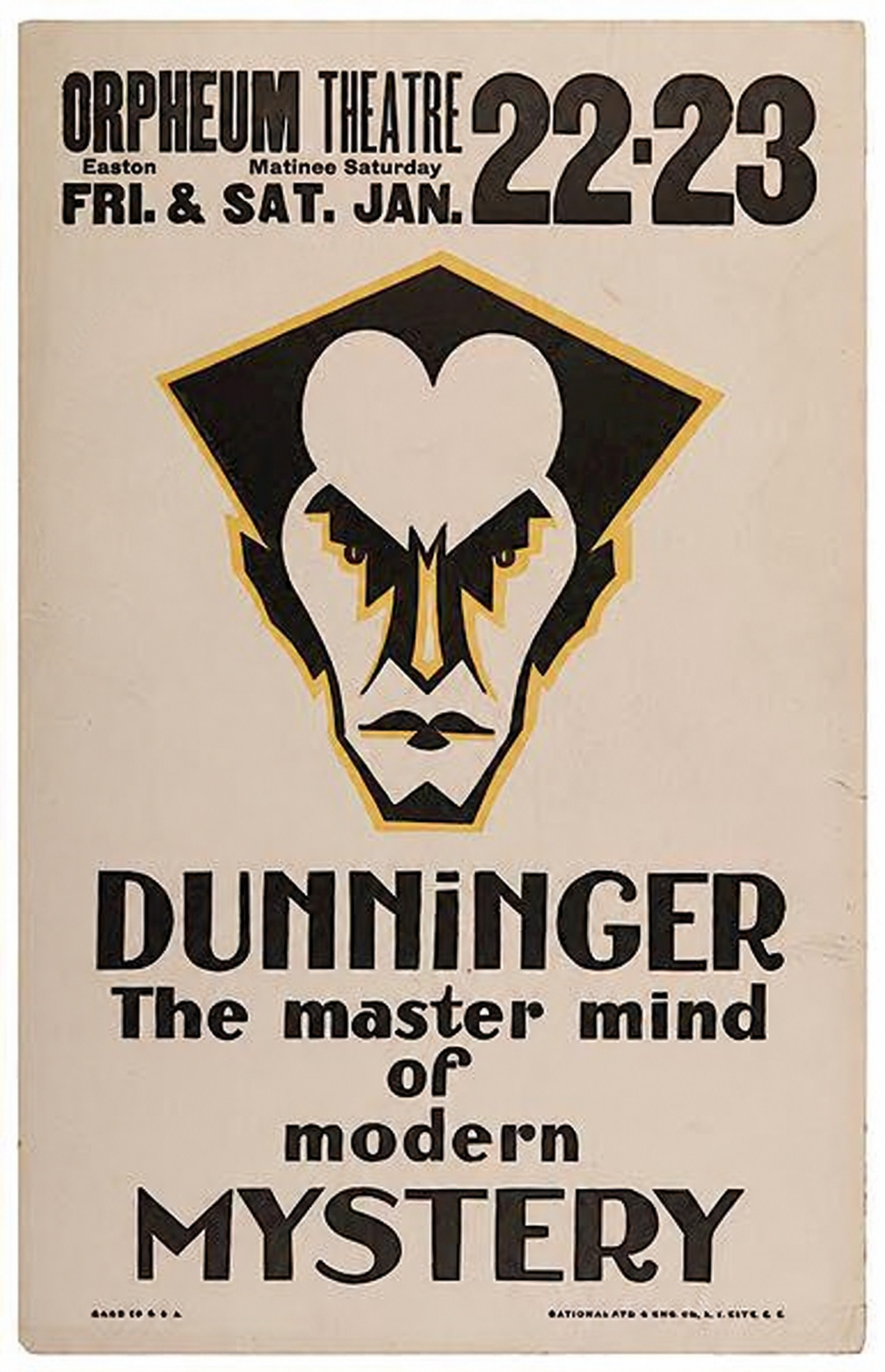
Poster No. 01 · circa 1935
Joseph
Dunninger
The Master-Mind of Modern Mystery
A face reduced to a symbol. A name made monumental. This poster does not reveal an illusion. It creates a question.
 Find a show
Poster No. 01 · circa 1935
The Master-Mind of Modern Mystery
A face reduced to a symbol. A name made monumental. This poster does not reveal an illusion. It creates a question.
Watch the poster story
Narrated by Dominic · Poe’s Magic Theatre at the Lord Baltimore Hotel
Watch on YouTube · Timestamps and references01
Cream, mustard yellow, black, and deep blue-green give the design its hard theatrical contrast. The oversized lettering acts almost as architecture, while Dunninger’s face becomes an emblem rather than a conventional portrait.
The staring eyes, radiating lines, and unusual heart-shaped silhouette direct everything toward the mind. Compared with the crowded spectacle of many nineteenth-century magic posters, this is spare, graphic, and psychologically charged.
The distinctive “bat wing” portrait was designed by artist Hans Stengel. The image was used in Dunninger publicity over many years; this style of window card is generally dated to about 1935.
02
Joseph Dunninger, born in 1892, became one of America’s best-known mentalists. His apparent mind reading reached audiences in theatres, on radio, and during television’s early years.
Spectators were asked to concentrate on names, drawings, private objects, and unspoken thoughts. Dunninger seemed to retrieve the answers at a distance. He insisted that he used no planted spectators or secret assistants, and openly challenged anyone who could prove otherwise.
“Stand here. Think of something. Say nothing.”
Welcome to the Magic Poster Tour at Poe’s Magic Theatre, inside the historic Lord Baltimore Hotel.
This window card advertises Joseph Dunninger at the Orpheum Theatre in Easton, where he was billed as “The Master-Mind of Modern Mystery.”
Before considering the performer, look at the artwork itself.
The designer uses a restrained palette of cream, mustard yellow, black, and deep blue-green. Heavy lettering dominates the composition, while the stylized face appears less like a portrait and more like a mysterious symbol. The staring eyes, radiating lines, and unusual heart-shaped form draw our attention toward the human mind, the true stage on which Dunninger performed.
Unlike the richly illustrated magic posters of the late nineteenth century, crowded with demons, assistants, and impossible spectacles, this design is strikingly modern. It relies on simplified shapes, dramatic contrast, and psychological suggestion. It does not show us what Dunninger will do. It asks us to imagine what he might know.
Dunninger became one of America’s most famous mentalists, bringing apparent mind reading to enormous audiences through theatre, radio, and early television. Listeners were invited to concentrate on names, drawings, private objects, and unspoken thoughts while he appeared to retrieve the answers from a distance.
He insisted that he used no planted spectators or secret assistants, and publicly challenged anyone who could prove otherwise.
This poster sold more than a performance. As a work of commercial art, it sold curiosity, uncertainty, and the mildly uncomfortable possibility that the man staring from the paper might already know why you stopped to look.
Stand here. Think of something. Say nothing.
Dunninger would have preferred it that way.