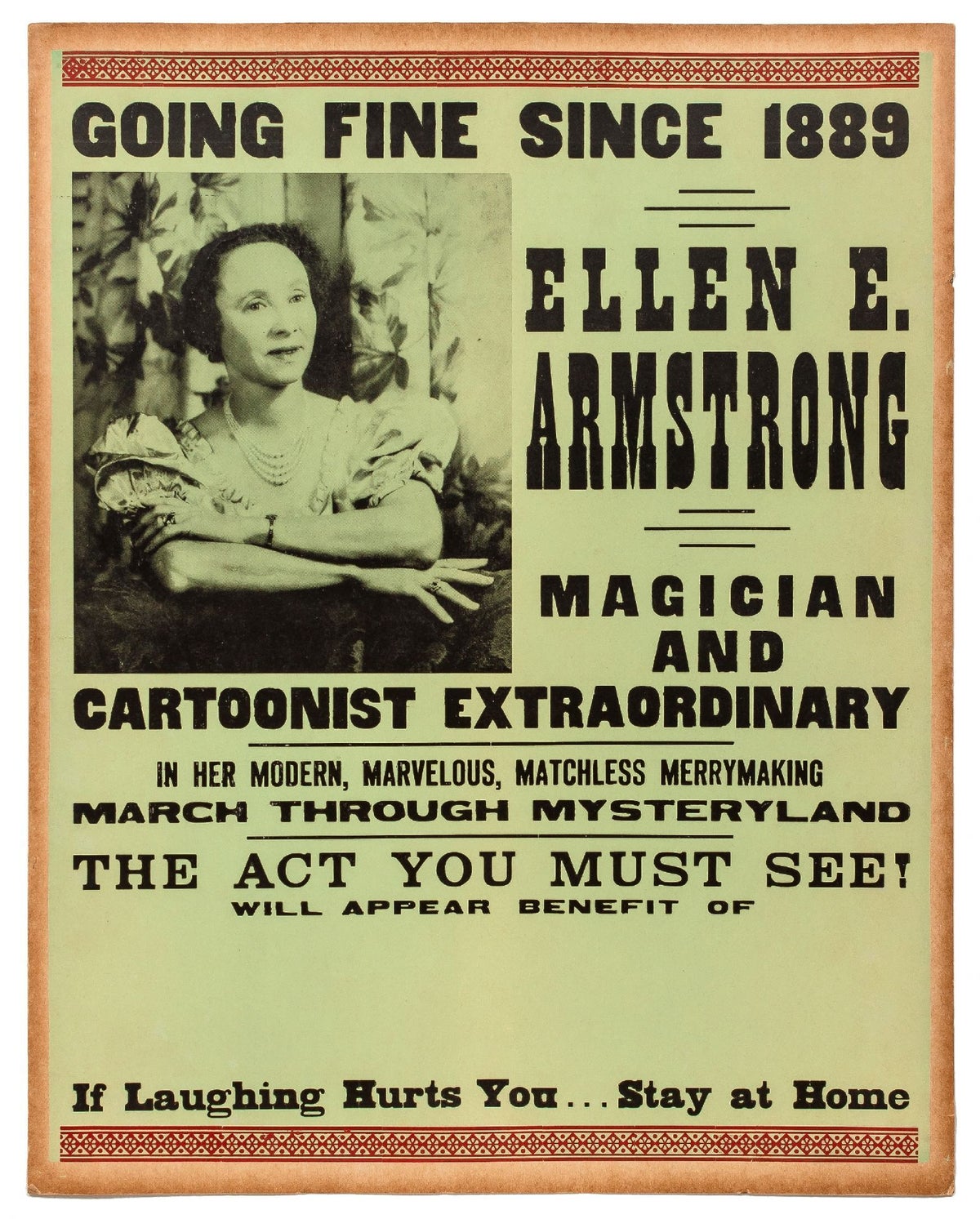
Poster No. 03 · circa 1940s
Ellen E.
Armstrong
Magician and Cartoonist Extraordinary
A portable poster, a towering name, and the finest health warning in show business: “If laughing hurts you, stay at home.”
 Find a show
Poster No. 03 · circa 1940s
Magician and Cartoonist Extraordinary
A portable poster, a towering name, and the finest health warning in show business: “If laughing hurts you, stay at home.”
Watch the poster story
Narrated by Dominic · Poe’s Magic Theatre at the Lord Baltimore Hotel
Watch on YouTube · Timestamps and references01
This is a working broadside rather than a lavish color lithograph. Black ink on cream paper keeps it economical, while narrow red patterned borders add just enough ceremony. Armstrong’s photograph supplies a human focus, and her name, set in towering condensed letters, supplies the volume.
The shifting type sizes create a fast, syncopated rhythm. A blank after “Will appear benefit of” could be completed by a local church, school, or community group. The design was made to be customized, posted, and carried to the next town.
Its most important visual choice is also its simplest: Armstrong is plainly visible. At a time when Black entertainers were routinely excluded or forced into stereotypes, the poster identifies a Black woman as the star and proprietor of a modern theatrical attraction. Her image is not decoration. It is authorship.
02
Ellen E. Armstrong learned magic in her father J. Hartford Armstrong’s touring company. After his death in the late 1930s, she took charge, reshaped the family act, and toured Black communities across the segregated South. She is recognized as the first known Black woman to headline a touring magic show.
Her programs mixed conjuring, comedy, cartooning, and “chemical, mechanical, and electrical” wonders. That independence was hard won. Her father had once been dropped from a performance when white organizers learned he was Black. Ellen’s enormous printed name and undisguised portrait answer that history with confidence, wit, and ownership.
“If laughing hurts you… stay at home.”
Welcome to the Magic Poster Tour at Poe’s Magic Theatre, inside the historic Lord Baltimore Hotel.
This poster introduces Ellen E. Armstrong, billed as a magician and cartoonist extraordinary. It was likely printed in the 1940s. The line across the top, ‘Going Fine Since 1889,’ is older than the poster. It advertises the Armstrong family’s theatrical tradition, begun by Ellen’s father, J. Hartford Armstrong.
Unlike the lavish color lithographs made for star illusionists, this is a practical touring broadside. Black ink, cream paper, and two narrow red ornamental borders keep the production economical and easy to reproduce. A photograph supplies the glamour. The rest is typography doing the work of a brass band.
Armstrong’s name dominates the page in tall, compressed letters. The text shifts in size and style as it moves downward, creating a lively visual rhythm. The blank after ‘Will appear benefit of’ allowed a local church, school, or community organization to add its own name. This was an adaptable working poster, built to travel.
The language is almost an act in itself: ‘Modern, marvelous, matchless merrymaking march through Mysteryland.’ And then comes the irresistible warning, ‘If laughing hurts you, stay at home.’ It is salesmanship with a raised eyebrow.
At left, Armstrong appears in costume, poised in mid-gesture. Her portrait matters. In an era when Black performers faced segregation, exclusion, and degrading stereotypes, this poster presents a Black woman plainly and proudly as the star, the skilled artist, and the owner of the attraction.
Armstrong grew up performing with her father at Black schools and churches along the East Coast. After his death in the late 1930s, she took command of the show, adapted his illusions, and toured for Black audiences across the segregated South. She is recognized as the first known Black woman to headline a touring magic act.
Her programs combined conjuring, comedy, cartooning, and demonstrations advertised as chemical, mechanical, and electrical magic. Reported routines included ‘Silken Sorcery’ and ‘The Puzzling Parasol.’ She inherited a family business, then made the performance distinctly her own.
That independence carried particular weight. Her father was once removed from a bill after white organizers learned he was Black. Other Black magicians sometimes adopted invented foreign identities to find work in an industry that would accept an exotic stereotype more readily than a Black American professional.
Armstrong’s poster takes another path. Her face is visible. Her name is enormous. Her authorship is unmistakable. It is more than an advertisement for a night of magic. It is a declaration of ownership, artistry, and presence.
And if laughing hurts you? Ellen Armstrong has already given her advice.