Poster No. 04 · 1929
Grover
George
The Supreme Master of Magic
Eighteen people. A carload of scenery. Three red devils. Modesty had apparently missed the train.
 Find a show
Poster No. 04 · 1929
The Supreme Master of Magic
Eighteen people. A carload of scenery. Three red devils. Modesty had apparently missed the train.
Watch the poster story
Narrated by Dominic · Poe’s Magic Theatre at the Lord Baltimore Hotel
Watch on YouTube · Timestamps and references01
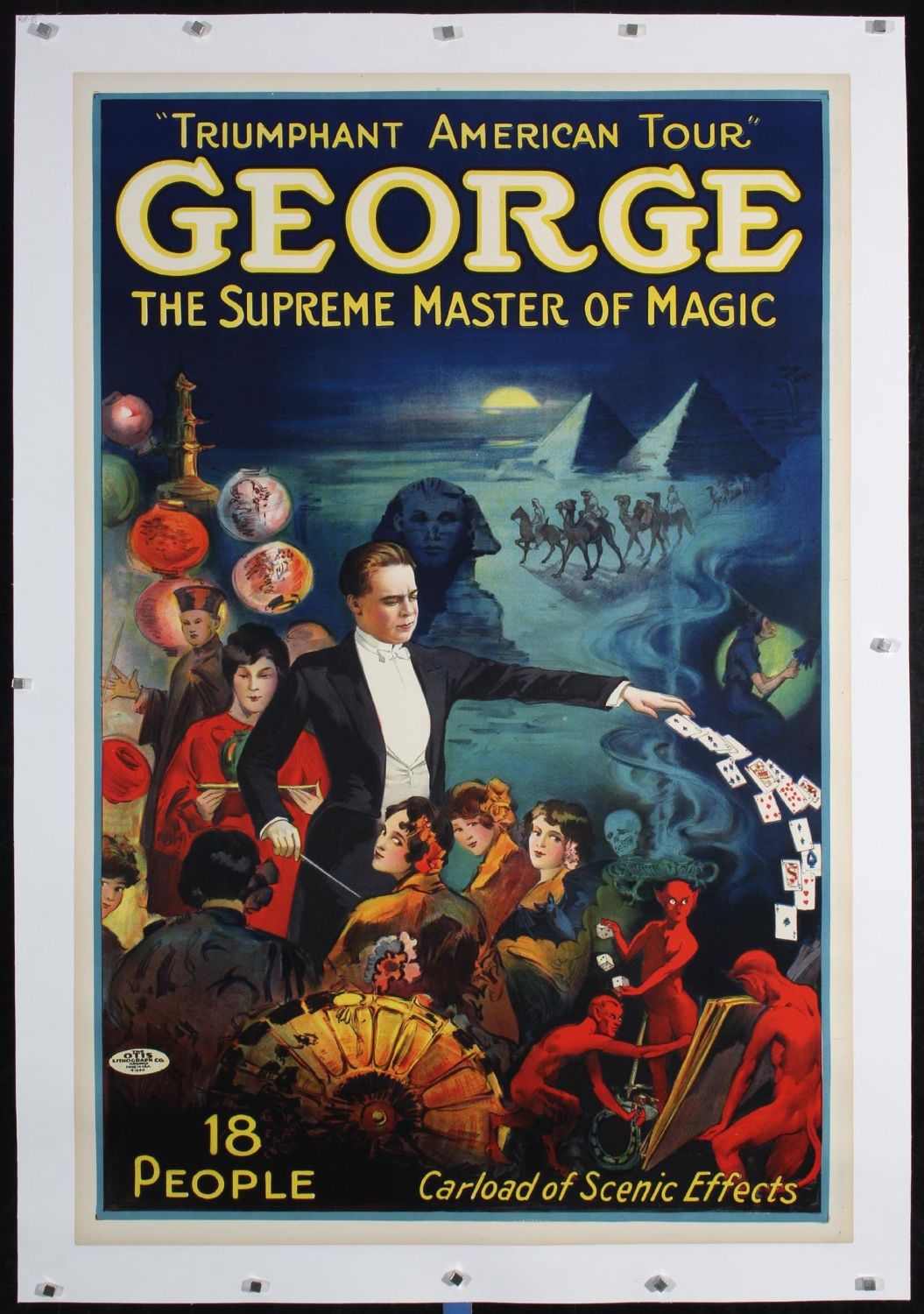
Otis Lithograph Company built the image from deep blue, theatrical gold, and sharp bursts of red. George anchors the confusion in formal white tie, producing a cascade of cards while lanterns, spectators, smoke, pyramids, a caravan, and assorted devils compete for the remaining oxygen.
It is commercial lithography as controlled excess. George’s enormous name works like a marquee, while the crowded scene converts “18 People” and a “Carload of Scenic Effects” into something the viewer can feel before reading the claim.
The poster treats Egypt, East Asia, desert travelers, witchcraft, and Christian devils as one convenient package labeled “mystery.” This Orientalist approach grew from racist assumptions, reducing distinct cultures to exotic scenery while placing George at the center of control. Poe’s Magic Theatre does not endorse that view. We display the poster as historical evidence and discuss its prejudice alongside its artistry.
02
Grover George was born in Zanesville, Ohio, in 1887 and began performing as a boy. He developed a large illusion show and enjoyed considerable success across Cuba, Mexico, and Central and South America.
His proposed American return met resistance from Howard Thurston, whose legal threats and influence with theatres reportedly disrupted George’s bookings. The “Triumphant American Tour” never matched the scale promised here. The poster became the grandest surviving version of a future that show business declined to provide.
“18 People · Carload of Scenic Effects”
Welcome to the Magic Poster Tour at Poe’s Magic Theatre, inside the historic Lord Baltimore Hotel.
This 1929 lithograph announces the triumphant American tour of Grover George, billed with customary restraint as the Supreme Master of Magic. It was printed in Cleveland by the Otis Lithograph Company.
The poster is crowded, cinematic, and determined to leave no patch of paper unemployed. George stands at the center in immaculate evening dress, calmly sending a stream of playing cards into the air. Around him, the image piles up promises: elegant spectators, glowing lanterns, a desert caravan, the Sphinx and pyramids, theatrical smoke, a witchlike figure, and three red devils apparently handling the scenery.
Deep blue unifies the composition. Gold lettering gives George’s name the scale of a theatre marquee, while the sharp red figures at the bottom drag the eye into a comic underworld. The printing is lush, using saturated color and finely modeled figures to make one touring company feel as large as an empire.
The small print is almost as boastful as the headline: eighteen people and a carload of scenic effects. The poster even appears to turn those numbers into a visual game, scattering a large cast and a cascade of cards across the scene.
Its imagery also deserves an honest look. Egypt, East Asia, desert travelers, witchcraft, and Christian devils are thrown together as interchangeable signs of the mysterious and foreign. This is Orientalism, a Western tradition rooted in racist assumptions that reduced distinct peoples and cultures to exotic decoration. Here, those cultures become scenery while George remains at the center, controlling the spectacle.
Poe’s Magic Theatre does not endorse that view of the world. We preserve the poster as history and can admire its artistic skill while speaking honestly about the prejudice within its design.
Grover George was born in Zanesville, Ohio, in eighteen eighty-seven and began performing magic as a boy. He later built an imposing illusion show and found substantial success in Cuba, Mexico, and Central and South America.
When he prepared his return to the United States, these posters promised a triumphant tour. The triumph proved less cooperative. Howard Thurston, then one of America’s dominant magicians, reportedly used legal threats and theatre connections to obstruct George’s bookings. The American tour never achieved the scale its publicity promised.
That failure gives the poster an odd afterlife. It advertises not simply a show, but a future George had ordered in magnificent color before the business of show business intervened. The lithograph survived. The grand tour, rather less so.