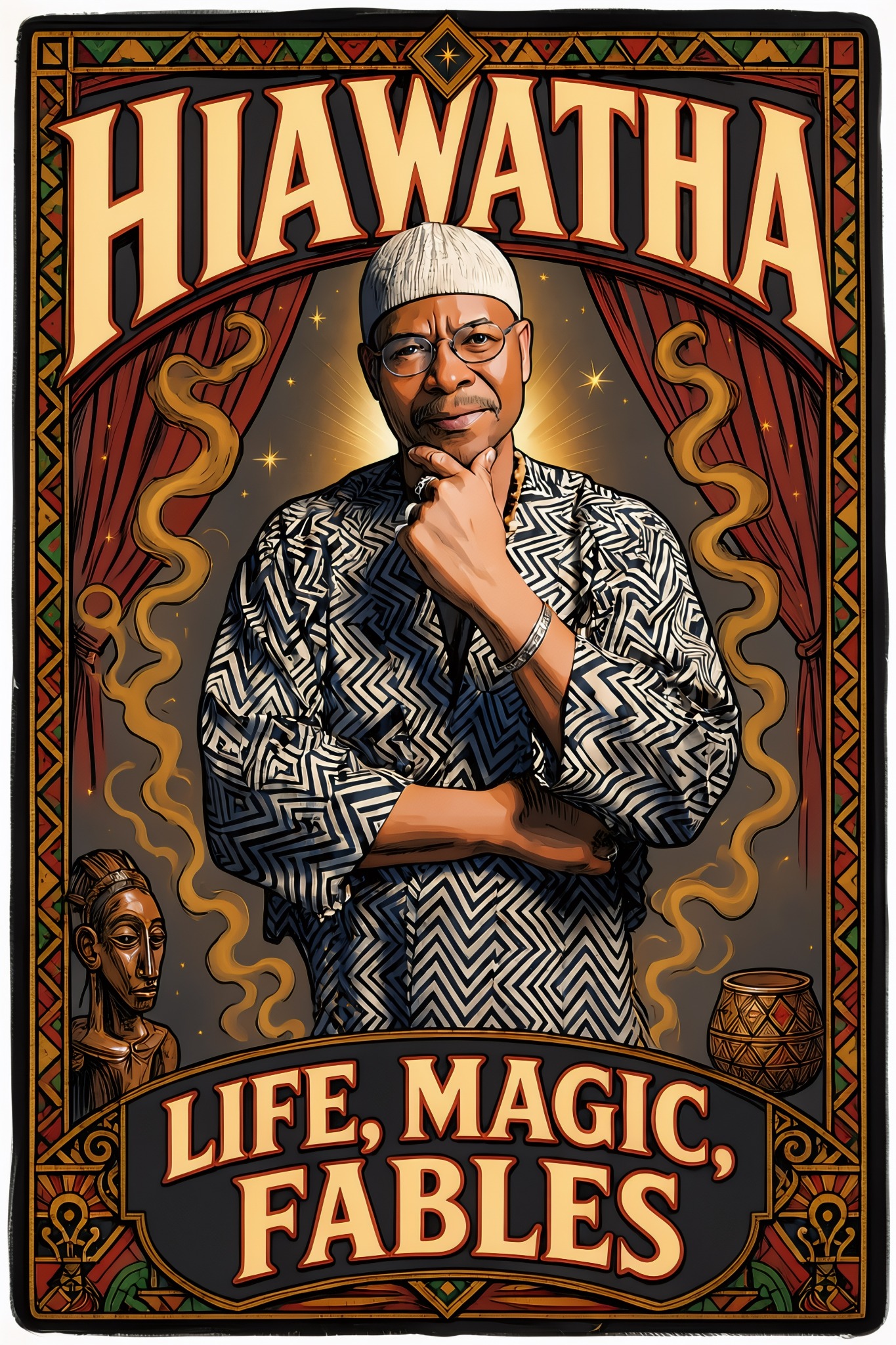
contemporary tribute poster
Hiawatha
Life, Magic, Fables
A magician, musician, teacher and storyteller who became a cherished part of Poe’s Magic Theatre.
 Find a show
contemporary tribute poster
Life, Magic, Fables
A magician, musician, teacher and storyteller who became a cherished part of Poe’s Magic Theatre.
Watch the poster story
Narrated by Dominic · Poe’s Magic Theatre at the Lord Baltimore Hotel
Watch on YouTube · Timestamps and references01
Welcome to the Magic Poster Tour at Poe's Magic Theatre in the Lord Baltimore Hotel. This contemporary Hiawatha poster bears the words Life, Magic, Fables. They introduce an entertainment artist whose career brought together conjuring, storytelling, music, and dance. His work belongs to the history of this theatre, and to a much wider community of performers and students.
This is a modern commemorative print, not an original-period advertising poster.
02
Hiawatha Johnson Junior was born in Lynchburg, Virginia, on July twentieth, 1956. He attended E. C. Glass High School and studied at Lynchburg College. His family remembered an artist who worked as a vocalist, director, producer, lecturer, musician, and magician. Entertainment Artist was his own description of a career that crossed the boundaries between those professions.
His daughters' remembrance in Genii traces his first performing experience to singing and playing piano for his father's gospel performances. Magic caught his imagination when his brother apparently rubbed a penny into his forearm. Mark Wilson's television series, The Magical Land of Allakazam, encouraged that interest. Max Maven later became an important mentor and adviser.
His signature work, Kalimba Talk, featured his alter ego Prince Junie, a name that grew from his father's nickname for Junior. Performances including The Secret of How to Fly combined West African artistic influences with magic, music, dance, and storytelling. Hiawatha developed a theatrical identity rooted in his own interests and cultural heritage.
The International Association of Black Magical Artists recognized the breadth of his work: choreography, composition, acting, writing, directing, and teaching. Its profile praised his ability to bring African cultural principles into his presentations. It also identified his role as special programs coordinator at Africa House Gallery and Studio in Lynchburg. His contribution extended beyond the magic stage into the wider arts community.
He founded and directed K T M A Arts, a national consortium of performing and visual artists based in Lynchburg. Collaboration was part of his professional life, alongside his own performances. In 2007, he became the first full-time artist to receive Lynchburg's Mayor's Award of Excellence. That local honor recognized a career whose influence reached well beyond the city.
Teaching young magicians was one of his lasting commitments. For more than twenty years, he taught and mentored at Tannen's Magic Camp. The obituary published by his family places that work alongside his performing and film career. Students encountered an artist whose experience included several forms of theatre, and whose example showed how much a magician could bring to a performance.
His workshops encouraged original routines and creative problem solving. Genii remembers programs including Open Minds and Understanding Parameters. In his tribute for The Linking Ring, Vince Wilson recalls Hiawatha as a mentor who took students seriously, recognized their potential, and helped them consider the purpose of their work. His teaching asked young performers to develop their own artistic judgment.
For more than thirty-five years, Hiawatha served the dance department at Randolph College, formerly Randolph-Macon Woman's College. His work included accompaniment and composition. In 2020, Randolph documented another contribution: he helped bring filmmaker Judd Ehrlich to campus and participated in its film series. Their friendship grew from their collaboration on Magic Camp, connecting his teaching to the college's public arts programming.
In 1994, Hiawatha became the third African American magician to appear on the cover of Genii. The December issue featured a substantial profile of his career. Further recognition came in 2015, when the Society of American Magicians presented him with its National Council Presidential Citation. These honors recognized the performer, teacher, and creative contributor behind the name.
His career also reached screen audiences. He appeared in the 1998 PBS special The Art of Magic, Judd Ehrlich's 2012 documentary Magic Camp, and the 2013 film Desperate Acts of Magic. Randolph's account identifies Magic Camp as a Newport Beach Film Festival award winner. The documentary brought the camp's young magicians, and the teachers supporting them, to a wider public.
At Poe's Magic Theatre, Hiawatha presented Life, Magic, Fables. Vince Wilson's published remembrance describes their friendship and Hiawatha's importance to the theatre's artistic life. Vince had first encountered his magic on television as a child. Years later, he welcomed that same artist to Baltimore as a performer, collaborator, and mentor. The poster preserves a connection to someone who helped make this theatre what it is.
Hiawatha died on January tenth, 2026, at the age of sixty-nine. He left a family, generations of students, fellow artists, and audiences who valued his work. In The Linking Ring, Vince remembers the generosity of a teacher and the lasting effect of his storytelling. His career gave magic a place within a larger life of music, movement, cultural expression, and human connection.
“Life, Magic, Fables”
Welcome to the Magic Poster Tour at Poe's Magic Theatre in the Lord Baltimore Hotel. This contemporary Hiawatha poster bears the words Life, Magic, Fables. They introduce an entertainment artist whose career brought together conjuring, storytelling, music, and dance. His work belongs to the history of this theatre, and to a much wider community of performers and students.
Hiawatha Johnson Junior was born in Lynchburg, Virginia, on July twentieth, 1956. He attended E. C. Glass High School and studied at Lynchburg College. His family remembered an artist who worked as a vocalist, director, producer, lecturer, musician, and magician. Entertainment Artist was his own description of a career that crossed the boundaries between those professions.
His daughters' remembrance in Genii traces his first performing experience to singing and playing piano for his father's gospel performances. Magic caught his imagination when his brother apparently rubbed a penny into his forearm. Mark Wilson's television series, The Magical Land of Allakazam, encouraged that interest. Max Maven later became an important mentor and adviser.
His signature work, Kalimba Talk, featured his alter ego Prince Junie, a name that grew from his father's nickname for Junior. Performances including The Secret of How to Fly combined West African artistic influences with magic, music, dance, and storytelling. Hiawatha developed a theatrical identity rooted in his own interests and cultural heritage.
The International Association of Black Magical Artists recognized the breadth of his work: choreography, composition, acting, writing, directing, and teaching. Its profile praised his ability to bring African cultural principles into his presentations. It also identified his role as special programs coordinator at Africa House Gallery and Studio in Lynchburg. His contribution extended beyond the magic stage into the wider arts community.
He founded and directed K T M A Arts, a national consortium of performing and visual artists based in Lynchburg. Collaboration was part of his professional life, alongside his own performances. In 2007, he became the first full-time artist to receive Lynchburg's Mayor's Award of Excellence. That local honor recognized a career whose influence reached well beyond the city.
Teaching young magicians was one of his lasting commitments. For more than twenty years, he taught and mentored at Tannen's Magic Camp. The obituary published by his family places that work alongside his performing and film career. Students encountered an artist whose experience included several forms of theatre, and whose example showed how much a magician could bring to a performance.
His workshops encouraged original routines and creative problem solving. Genii remembers programs including Open Minds and Understanding Parameters. In his tribute for The Linking Ring, Vince Wilson recalls Hiawatha as a mentor who took students seriously, recognized their potential, and helped them consider the purpose of their work. His teaching asked young performers to develop their own artistic judgment.
For more than thirty-five years, Hiawatha served the dance department at Randolph College, formerly Randolph-Macon Woman's College. His work included accompaniment and composition. In 2020, Randolph documented another contribution: he helped bring filmmaker Judd Ehrlich to campus and participated in its film series. Their friendship grew from their collaboration on Magic Camp, connecting his teaching to the college's public arts programming.
In 1994, Hiawatha became the third African American magician to appear on the cover of Genii. The December issue featured a substantial profile of his career. Further recognition came in 2015, when the Society of American Magicians presented him with its National Council Presidential Citation. These honors recognized the performer, teacher, and creative contributor behind the name.
His career also reached screen audiences. He appeared in the 1998 PBS special The Art of Magic, Judd Ehrlich's 2012 documentary Magic Camp, and the 2013 film Desperate Acts of Magic. Randolph's account identifies Magic Camp as a Newport Beach Film Festival award winner. The documentary brought the camp's young magicians, and the teachers supporting them, to a wider public.
At Poe's Magic Theatre, Hiawatha presented Life, Magic, Fables. Vince Wilson's published remembrance describes their friendship and Hiawatha's importance to the theatre's artistic life. Vince had first encountered his magic on television as a child. Years later, he welcomed that same artist to Baltimore as a performer, collaborator, and mentor. The poster preserves a connection to someone who helped make this theatre what it is.
Hiawatha died on January tenth, 2026, at the age of sixty-nine. He left a family, generations of students, fellow artists, and audiences who valued his work. In The Linking Ring, Vince remembers the generosity of a teacher and the lasting effect of his storytelling. His career gave magic a place within a larger life of music, movement, cultural expression, and human connection.
Keep the Magic Alive was Hiawatha's enduring message. This poster honors a life devoted to making and sharing art. Like this video and subscribe to Poe's Magic for more stories from our Magic Poster Tour. Visit poesmagic dot com to explore the collection.