circa 1904
Challenge to Houdini
Regent Theatre, Salford
An extra-strong travelling basket meets a man whose profession is leaving things. The committee has brought ropes. Houdini has brought publicity.
 Find a show
circa 1904
Regent Theatre, Salford
An extra-strong travelling basket meets a man whose profession is leaving things. The committee has brought ropes. Houdini has brought publicity.
Watch the poster story
Narrated by Dominic · Poe’s Magic Theatre at the Lord Baltimore Hotel
Watch on YouTube · Timestamps and references01
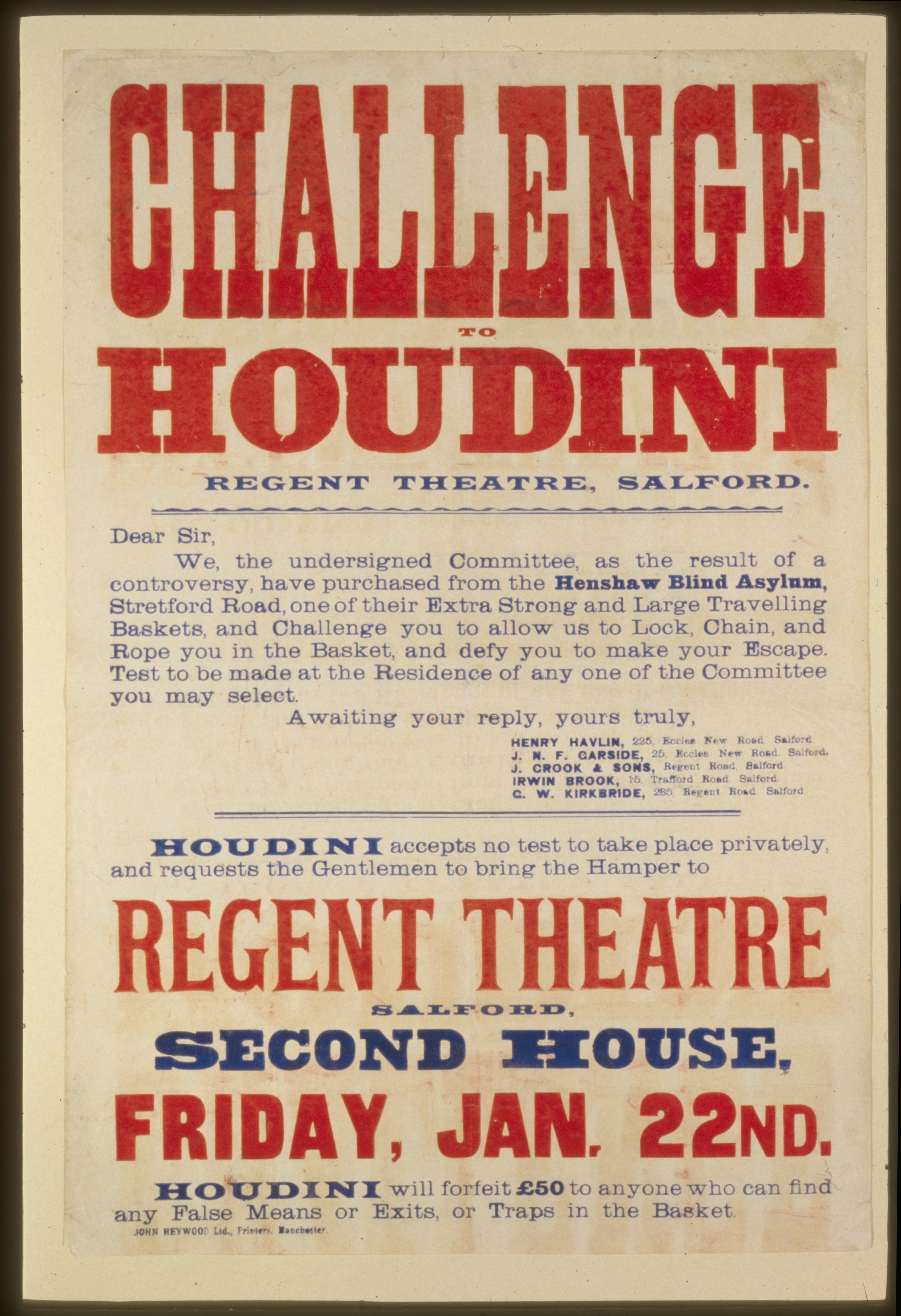
The word Challenge nearly fills the top of the sheet. Houdini follows in enormous red letters, while dark blue type supplies the theatre, the terms, and the reply. There is no portrait and no picture of an escape. This is a typographic theatrical broadside: contrasting letter sizes, emphatic color, dividing rules, and a letter printed as evidence. The argument itself becomes the artwork.
The committee says it purchased a large, extra-strong travelling basket from the Henshaw Blind Asylum on Stretford Road. Its members propose locking, chaining, and roping Houdini inside, with the test held at a committee member's residence. Their names and street addresses appear below the letter. Those ordinary local details make the extraordinary challenge feel tangible. Somebody has a basket, somebody has a house, and apparently everybody has an opinion.
Houdini's printed answer declines a private test. Instead, the committee should bring the hamper to the Regent Theatre in Salford for the second house on Friday, January twenty-second. He offers fifty pounds to anyone who discovers a false exit, trap, or other false means in the basket. Notice how the reply converts a proposed private experiment into a public attraction. The large red theatre name does almost as much work as the challenge above it.
The small imprint at the foot names John Heywood Limited, printers in Manchester. The Library of Congress catalogs this sheet as a color lithograph and tentatively dates it to 1904; the printed date itself gives no year. No individual designer is identified in that catalog record. Its blunt display lettering belongs to the practical tradition of theatre bills and public notices, where urgency matters more than decorative illustration.
02
Harry Houdini was born in Budapest in 1874 and grew up in the United States. He adopted a stage name inspired by the French conjurer Robert-Houdin, performed with his wife Bess, and became internationally famous for escapes from handcuffs and other restraints. His career expanded into spectacular public escapes, film, and theatrical magic.
This poster shows a particularly effective part of his showmanship: letting a challenge become the story. The confinement had to sound convincing, the conditions had to be understood, and the audience needed a reason to care before he began. Here, Houdini turns the committee's doubts into an invitation to the theatre. Escaping the basket would be his problem. Filling the seats had already become everyone else's conversation.
“Challenge to Houdini”
Welcome to the Magic Poster Tour at Poe’s Magic Theatre, inside the historic Lord Baltimore Hotel.
This stop features Challenge to Houdini, a circa 1904 piece billed as “Regent Theatre, Salford.”
The word Challenge nearly fills the top of the sheet. Houdini follows in enormous red letters, while dark blue type supplies the theatre, the terms, and the reply. There is no portrait and no picture of an escape. This is a typographic theatrical broadside: contrasting letter sizes, emphatic color, dividing rules, and a letter printed as evidence. The argument itself becomes the artwork.
The committee says it purchased a large, extra-strong travelling basket from the Henshaw Blind Asylum on Stretford Road. Its members propose locking, chaining, and roping Houdini inside, with the test held at a committee member's residence. Their names and street addresses appear below the letter. Those ordinary local details make the extraordinary challenge feel tangible. Somebody has a basket, somebody has a house, and apparently everybody has an opinion.
Houdini's printed answer declines a private test. Instead, the committee should bring the hamper to the Regent Theatre in Salford for the second house on Friday, January twenty-second. He offers fifty pounds to anyone who discovers a false exit, trap, or other false means in the basket. Notice how the reply converts a proposed private experiment into a public attraction. The large red theatre name does almost as much work as the challenge above it.
The small imprint at the foot names John Heywood Limited, printers in Manchester. The Library of Congress catalogs this sheet as a color lithograph and tentatively dates it to 1904; the printed date itself gives no year. No individual designer is identified in that catalog record. Its blunt display lettering belongs to the practical tradition of theatre bills and public notices, where urgency matters more than decorative illustration.
Harry Houdini was born in Budapest in 1874 and grew up in the United States. He adopted a stage name inspired by the French conjurer Robert-Houdin, performed with his wife Bess, and became internationally famous for escapes from handcuffs and other restraints. His career expanded into spectacular public escapes, film, and theatrical magic.
This poster shows a particularly effective part of his showmanship: letting a challenge become the story. The confinement had to sound convincing, the conditions had to be understood, and the audience needed a reason to care before he began. Here, Houdini turns the committee's doubts into an invitation to the theatre. Escaping the basket would be his problem. Filling the seats had already become everyone else's conversation.