circa 1910–1912
Ionia
L’Enchantresse
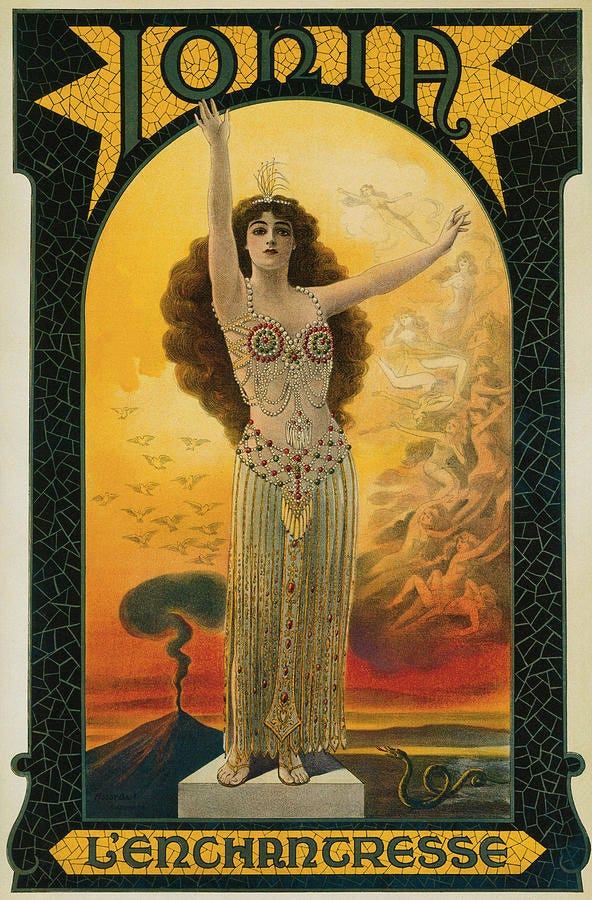
Ionia raises one hand and an entire supernatural ecosystem reports for duty. Volcano, spirits, birds, and serpent, all present and apparently awaiting instructions.
 Find a show
circa 1910–1912
L’Enchantresse
Ionia raises one hand and an entire supernatural ecosystem reports for duty. Volcano, spirits, birds, and serpent, all present and apparently awaiting instructions.
Watch the poster story
Narrated by Dominic · Poe’s Magic Theatre at the Lord Baltimore Hotel
Watch on YouTube · Timestamps and references01
This richly colored lithograph belongs to the Art Nouveau era, with its elongated figure, curving lettering, mosaic-like border, jewel ornament, and flowing movement. Ionia stands on a white pedestal at the center, her pale costume and raised arms set against a golden circle like a theatrical halo.
Around her, the natural and supernatural worlds erupt together. Birds stream across the sky, a volcano smolders below, a serpent curls near her feet, and ghostly figures rise through smoke at her side. Such imagery gave stage magicians an aura of forbidden power without making a literal claim to sorcery. In this case, the woman is not an assistant endangered by the mystery. She commands it.
The costume and fantasy setting also draw upon the period’s taste for generalized exoticism. Distinct cultures were often blended into decorative signs of mystery for Western audiences. The artistry deserves attention, but so does the habit of treating cultural difference as theatrical costume.
The work displayed at Poe’s Magic Theatre is a reproduction.
02
Ionia was the stage identity of Clementine de Vere, born in Brussels in 1888 into a family of magicians. Her father, Charles de Vere, developed an enormous illusion production for her, and she appeared across European stages during a brief but spectacular career beginning around 1910.
Her show reportedly required tons of equipment, elaborate costumes, assistants, animals, and large illusions. Moody Brothers of Birmingham produced a celebrated series of posters for the act. Only a portion of those designs are known to survive, which has helped make Ionia’s advertising nearly as famous as the short-lived production itself.
“L’Enchantresse”
Welcome to the Magic Poster Tour at Poe’s Magic Theatre, inside the historic Lord Baltimore Hotel.
This stop features Ionia, L’Enchantresse, a circa 1910–1912 piece billed as “L’Enchantresse.”
This richly colored lithograph belongs to the Art Nouveau era, with its elongated figure, curving lettering, mosaic-like border, jewel ornament, and flowing movement. Ionia stands on a white pedestal at the center, her pale costume and raised arms set against a golden circle like a theatrical halo.
Around her, the natural and supernatural worlds erupt together. Birds stream across the sky, a volcano smolders below, a serpent curls near her feet, and ghostly figures rise through smoke at her side. Such imagery gave stage magicians an aura of forbidden power without making a literal claim to sorcery. In this case, the woman is not an assistant endangered by the mystery. She commands it.
The costume and fantasy setting also draw upon the period’s taste for generalized exoticism. Distinct cultures were often blended into decorative signs of mystery for Western audiences. The artistry deserves attention, but so does the habit of treating cultural difference as theatrical costume.
The work displayed at Poe’s Magic Theatre is a reproduction.
Ionia was the stage identity of Clementine de Vere, born in Brussels in 1888 into a family of magicians. Her father, Charles de Vere, developed an enormous illusion production for her, and she appeared across European stages during a brief but spectacular career beginning around 1910.
Her show reportedly required tons of equipment, elaborate costumes, assistants, animals, and large illusions. Moody Brothers of Birmingham produced a celebrated series of posters for the act. Only a portion of those designs are known to survive, which has helped make Ionia’s advertising nearly as famous as the short-lived production itself.