circa 1875
Maskelyne & Cooke
Psycho, the Automaton Whist Player
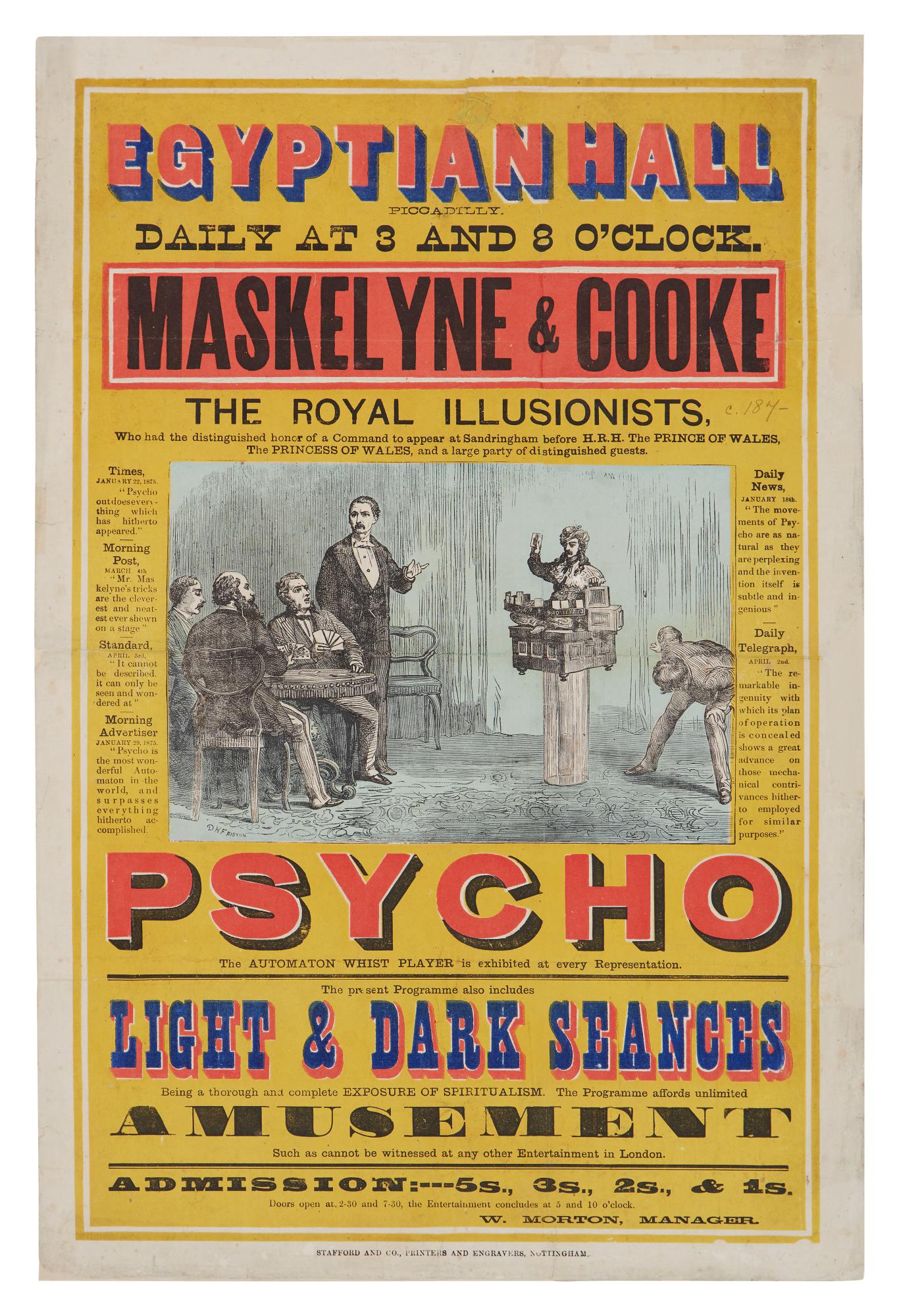
A mechanical card player sits on a transparent cylinder. The audience has come to inspect him. He appears to have the better hand.
 Find a show
circa 1875
Psycho, the Automaton Whist Player
A mechanical card player sits on a transparent cylinder. The audience has come to inspect him. He appears to have the better hand.
Watch the poster story
Narrated by Dominic · Poe’s Magic Theatre at the Lord Baltimore Hotel
Watch on YouTube · Timestamps and references01
Egyptian Hall and the names Maskelyne and Cooke occupy the top of this yellow playbill. Below them, a carefully drawn gathering watches Psycho, the small seated figure billed as an automaton whist player. His transparent support is part of the sales pitch: the picture invites us to look beneath him and decide that there is nowhere for a secret to hide. The gigantic red word Psycho makes certain that even a passing pedestrian knows the star attraction.
Stafford and Co., the Nottingham printing firm, produced the poster around 1875. Sotheby's identifies the central transferred woodcut as the work of illustrator David Henry Friston. That credits the picture, without assuming Friston designed every letter and border. The sheet combines color lithography, letterpress text, and the reproduced woodcut: a characteristic Victorian mixture of vivid display type, dense reviews, and detailed narrative illustration.
The smaller print works hard. There are royal-performance credentials, newspaper endorsements, afternoon and evening showtimes, and admission prices from one to five shillings. Light and Dark Séances share the bill, advertised as an exposure of Spiritualism. The manager's name, W. Morton, appears at the foot. A handwritten circa 1874 note survives on this copy, but the catalogue dates the sheet circa 1875, consistent with Psycho's January 1875 debut.
02
John Nevil Maskelyne and George Alfred Cooke established their long-running partnership at London's Egyptian Hall in 1873. Their entertainment joined stage illusions, theatrical scenes, mechanical ingenuity, and demonstrations of supposed spirit phenomena. They gave audiences something to argue about after the curtain came down.
Psycho could select playing cards, answer questions with movements of his head, and even smoke. He was presented as a thinking machine, years before electronic computers. London Museum preserves the figure and records more than four thousand Egyptian Hall performances, followed by a final appearance in 1910. The poster captures the appeal beautifully: a roomful of intelligent people trying to understand a little gentleman who refuses to explain himself.
“Psycho, the Automaton Whist Player”
Welcome to the Magic Poster Tour at Poe’s Magic Theatre, inside the historic Lord Baltimore Hotel.
This stop features Maskelyne & Cooke, Psycho, a circa 1875 piece billed as “Psycho, the Automaton Whist Player.”
Egyptian Hall and the names Maskelyne and Cooke occupy the top of this yellow playbill. Below them, a carefully drawn gathering watches Psycho, the small seated figure billed as an automaton whist player. His transparent support is part of the sales pitch: the picture invites us to look beneath him and decide that there is nowhere for a secret to hide. The gigantic red word Psycho makes certain that even a passing pedestrian knows the star attraction.
Stafford and Co., the Nottingham printing firm, produced the poster around 1875. Sotheby's identifies the central transferred woodcut as the work of illustrator David Henry Friston. That credits the picture, without assuming Friston designed every letter and border. The sheet combines color lithography, letterpress text, and the reproduced woodcut: a characteristic Victorian mixture of vivid display type, dense reviews, and detailed narrative illustration.
The smaller print works hard. There are royal-performance credentials, newspaper endorsements, afternoon and evening showtimes, and admission prices from one to five shillings. Light and Dark Séances share the bill, advertised as an exposure of Spiritualism. The manager's name, W. Morton, appears at the foot. A handwritten circa 1874 note survives on this copy, but the catalogue dates the sheet circa 1875, consistent with Psycho's January 1875 debut.
John Nevil Maskelyne and George Alfred Cooke established their long-running partnership at London's Egyptian Hall in 1873. Their entertainment joined stage illusions, theatrical scenes, mechanical ingenuity, and demonstrations of supposed spirit phenomena. They gave audiences something to argue about after the curtain came down.
Psycho could select playing cards, answer questions with movements of his head, and even smoke. He was presented as a thinking machine, years before electronic computers. London Museum preserves the figure and records more than four thousand Egyptian Hall performances, followed by a final appearance in 1910. The poster captures the appeal beautifully: a roomful of intelligent people trying to understand a little gentleman who refuses to explain himself.