Poe's Magic TheatreFind a show
Aged cream theatrical broadside headed Ventriloquism, Mr. and Mrs. Potter
Reproduction displayed at Poe’s Magic Theatre Tap to open full image

early nineteenth century

Richard Potter

Ventriloquism and 400 Curious but Mysterious Experiments

Listen to the story

A Founding Figure of American Magic

Narrated by Dominic

The broadside promises four hundred mysterious experiments. More importantly, it names Richard Potter, the first American-born magician to achieve national fame and one of the earliest Black celebrities in the United States.

01

The artwork

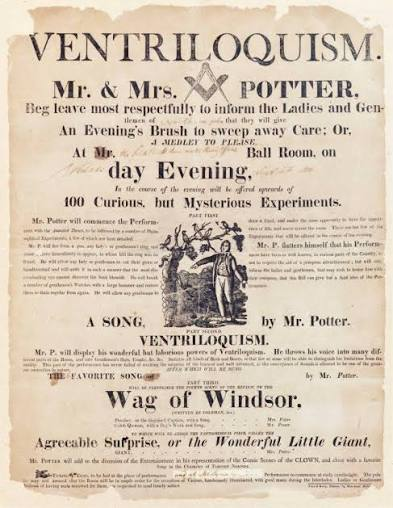
This densely printed broadside is built from type rather than color illustration. The largest words announce ventriloquism and Mr. and Mrs. Potter, with a Masonic square and compass printed between their names. Smaller lines crowd the sheet with songs, comic pieces, mysterious experiments, and theatrical claims.

Changes in type size guide the eye through an enormous program. A small central engraving breaks the columns, but language is the principal spectacle. The worn cream paper and tightly packed letterpress printing belong to the working world of early nineteenth-century theatre advertising, when one sheet had to introduce the performers, list the program, and persuade a passerby that four hundred experiments could fit into one evening without requiring breakfast.

The broadside is attributed to Richard and Sally Potter. Its precise printing date remains under research.

02

The performer

Richard Potter was born in Massachusetts around 1783. He worked with the Scottish magician and ventriloquist John Rannie before beginning his own career around 1811. Potter performed magic, ventriloquism, and feats then advertised as experiments in hypnotism, touring widely along the East Coast and as far south as Alabama.

Potter’s success was extraordinary in a country structured by slavery and racial discrimination. He was refused accommodation at a hotel in Mobile because he was Black, yet continued the engagement and drew substantial audiences. Modern historians recognize him as the first American-born magician to gain national fame and, by some accounts, the first Black American celebrity.

The Mrs. Potter named on the broadside was his wife, Sally Harris Potter. They married in 1808, and the billing presents her as part of the theatrical company rather than leaving her outside his public career. The Potters later established a large property in Andover, New Hampshire. The surrounding community still carries the name Potter Place.

Richard Potter was also connected with African Lodge Number 459 and the early history of Prince Hall Freemasonry. He died in 1835. His importance reaches beyond the survival of one crowded sheet. He belongs near the beginning of American professional magic, although the standard histories took an embarrassingly long time to make enough room for him.
400 Curious but Mysterious Experiments
Read the complete audio transcript

Welcome to the Magic Poster Tour at Poe’s Magic Theatre, inside the historic Lord Baltimore Hotel.

This stop features Richard and Sally Potter, a early nineteenth century piece billed as “Ventriloquism and 400 Curious but Mysterious Experiments.”

This densely printed broadside is built from type rather than color illustration. The largest words announce ventriloquism and Mr. and Mrs. Potter, with a Masonic square and compass printed between their names. Smaller lines crowd the sheet with songs, comic pieces, mysterious experiments, and theatrical claims.

Changes in type size guide the eye through an enormous program. A small central engraving breaks the columns, but language is the principal spectacle. The worn cream paper and tightly packed letterpress printing belong to the working world of early nineteenth-century theatre advertising, when one sheet had to introduce the performers, list the program, and persuade a passerby that four hundred experiments could fit into one evening without requiring breakfast.

The broadside is attributed to Richard and Sally Potter. Its precise printing date remains under research.

Richard Potter was born in Massachusetts around 1783. He worked with the Scottish magician and ventriloquist John Rannie before beginning his own career around 1811. Potter performed magic, ventriloquism, and feats then advertised as experiments in hypnotism, touring widely along the East Coast and as far south as Alabama.

Potter’s success was extraordinary in a country structured by slavery and racial discrimination. He was refused accommodation at a hotel in Mobile because he was Black, yet continued the engagement and drew substantial audiences. Modern historians recognize him as the first American-born magician to gain national fame and, by some accounts, the first Black American celebrity.

The Mrs. Potter named on the broadside was his wife, Sally Harris Potter. They married in 1808, and the billing presents her as part of the theatrical company rather than leaving her outside his public career. The Potters later established a large property in Andover, New Hampshire. The surrounding community still carries the name Potter Place.

Richard Potter was also connected with African Lodge Number 459 and the early history of Prince Hall Freemasonry. He died in 1835. His importance reaches beyond the survival of one crowded sheet. He belongs near the beginning of American professional magic, although the standard histories took an embarrassingly long time to make enough room for him.