circa 1910–1920
The Wanda’s
Goddess of Mystery
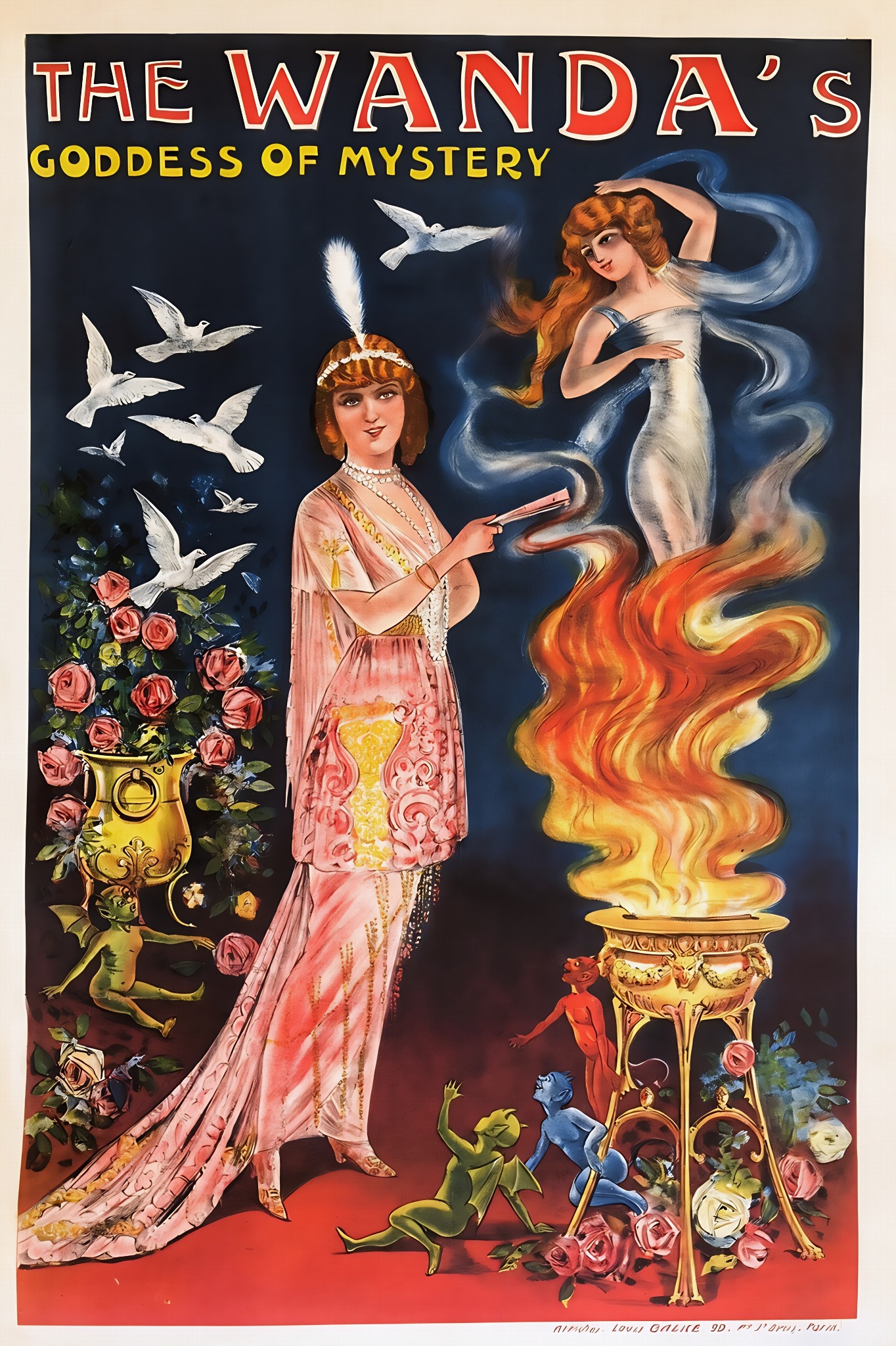
Birds, flowers, smoke, flames, frogs, and a title with a mysterious apostrophe. The poster has brought everything.
 Find a show
circa 1910–1920
Goddess of Mystery
Birds, flowers, smoke, flames, frogs, and a title with a mysterious apostrophe. The poster has brought everything.
Watch the poster story
Narrated by Dominic · Poe’s Magic Theatre at the Lord Baltimore Hotel
Watch on YouTube · Timestamps and references01
A woman in jeweled costume stands between white birds and a smoking brazier, framed by flowers, strange creatures, and warm orange light. The narrow format and symmetrical arrangement give her the stillness of an icon while the natural world seems to erupt around her.
Its costume and title use an imagined exotic setting rather than a specific culture. That Orientalist approach turned cultural difference into decoration for Western audiences. It is not harmless fantasy, and Poe’s Magic Theatre does not endorse it. We can recognize the color lithography’s skill while naming the assumptions embedded in the image.
02
The precise identity behind ‘The Wanda’s’ is less securely documented than the major names in this collection. That uncertainty is part of poster history. Advertising sheets often outlived the performers, companies, and local records they were meant to serve.
What survives is a carefully manufactured persona: not simply a magician, but a goddess whose authority comes from costume, stillness, and a surrounding storm of impossible life.
“Goddess of Mystery”
Welcome to the Magic Poster Tour at Poe’s Magic Theatre, inside the historic Lord Baltimore Hotel.
This stop features The Wanda’s, a circa 1910–1920 piece billed as “Goddess of Mystery.”
A woman in jeweled costume stands between white birds and a smoking brazier, framed by flowers, strange creatures, and warm orange light. The narrow format and symmetrical arrangement give her the stillness of an icon while the natural world seems to erupt around her.
Its costume and title use an imagined exotic setting rather than a specific culture. That Orientalist approach turned cultural difference into decoration for Western audiences. It is not harmless fantasy, and Poe’s Magic Theatre does not endorse it. We can recognize the color lithography’s skill while naming the assumptions embedded in the image.
The precise identity behind ‘The Wanda’s’ is less securely documented than the major names in this collection. That uncertainty is part of poster history. Advertising sheets often outlived the performers, companies, and local records they were meant to serve.
What survives is a carefully manufactured persona: not simply a magician, but a goddess whose authority comes from costume, stillness, and a surrounding storm of impossible life.