circa 1910
The Zancigs
Two Minds with but a Single Thought
Niagara Falls, ships, trains, city towers, and mind reading. The poster appears determined to include the entire continent.
 Find a show
circa 1910
Two Minds with but a Single Thought
Niagara Falls, ships, trains, city towers, and mind reading. The poster appears determined to include the entire continent.
Watch the poster story
Narrated by Dominic · Poe’s Magic Theatre at the Lord Baltimore Hotel
Watch on YouTube · Timestamps and references01
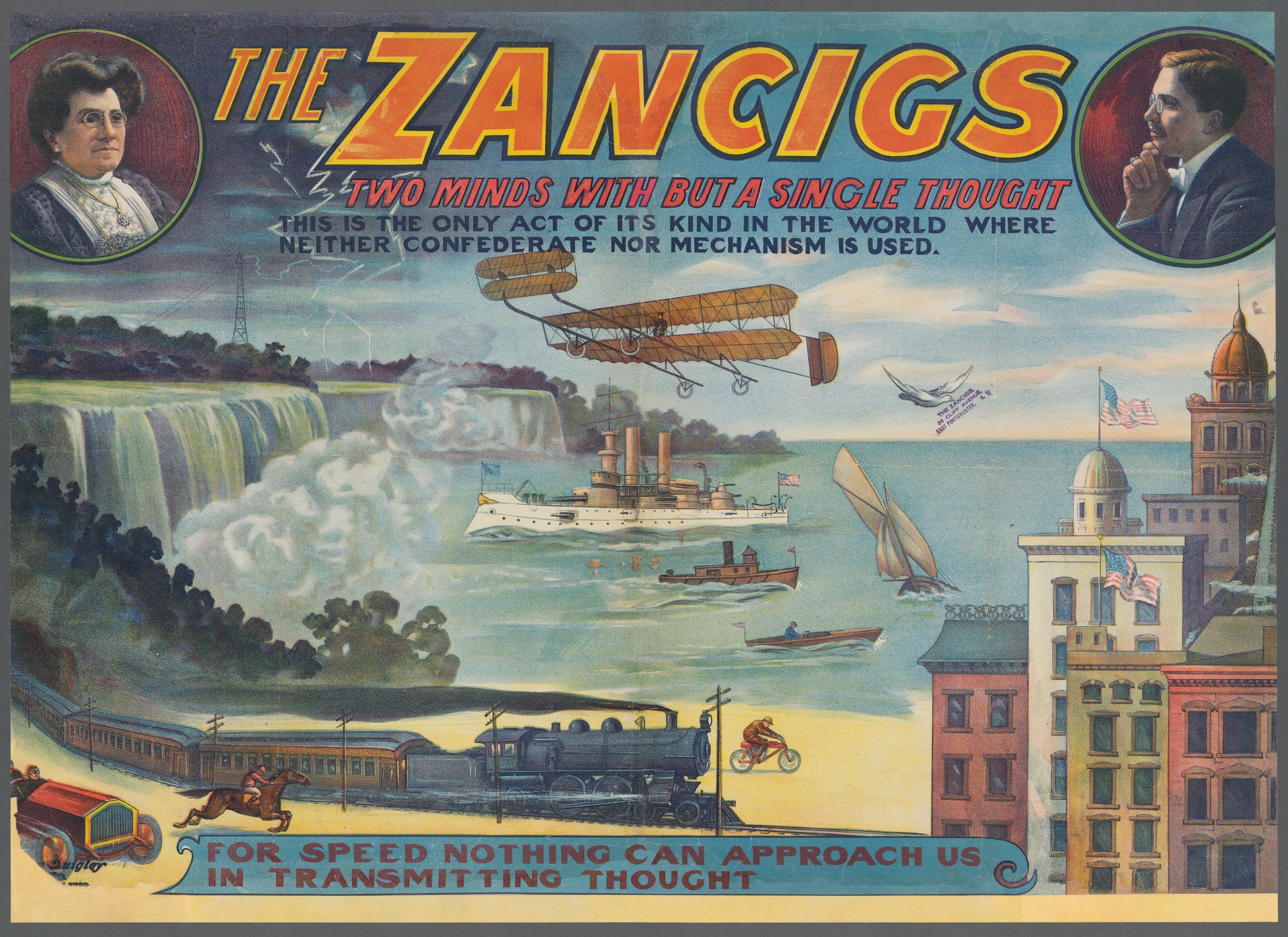
Agnes and Julius Zancig look down from portrait medallions onto a world furiously trying to get somewhere. Niagara Falls crashes at the left. A biplane crosses the sky, a wireless mast throws out lightning, and steamships, smaller boats, a railway train, a motorcycle, a motorcar, and a rider on horseback fill the scene. The bottom banner claims that nothing can approach the pair's speed in transmitting thought. Every machine has been recruited as a slower competitor.
The New York Public Library dates this color lithograph to about 1910 and identifies Ackermann-Quigley Litho. Co. as its printer. The individual artist is not named in the records consulted. The design belongs to early twentieth-century theatrical advertising: bright color, slanting display letters, portrait medallions, and a panoramic montage that turns a complicated claim into a picture. Its visual argument is modernity. Telepathy is advertised as the next advance beyond the railway and the wireless.
Look beside the small white bird beneath the aircraft. The surviving library copy carries a contact overprint for the Zancigs at 36 Cliff Avenue, East Portchester, New York. That is a later layer of practical publicity on top of the grand claim. Even thoughts that outrun steamships apparently need a postal address.
02
The Danish-born Julius and Agnes Zancig became internationally known for a two-person thought-reading act. Julius moved among the spectators while Agnes identified objects or information that she seemed unable to see. Their fluent partnership made the exchange feel immediate, which is exactly the quality this poster translates into trains, aircraft, and electrical flashes.
Their performances drew attention from audiences and investigators interested in telepathy. Agnes and Julius worked together until her death in 1916, after which Julius continued with other partners. Their influence survives in the paired mind-reading acts that followed them. Here, their public identity is a partnership: two portraits, two minds, one astonishingly confident advertising claim.
“Two Minds with but a Single Thought”
Welcome to the Magic Poster Tour at Poe’s Magic Theatre, inside the historic Lord Baltimore Hotel.
This stop features The Zancigs, a circa 1910 piece billed as “Two Minds with but a Single Thought.”
Agnes and Julius Zancig look down from portrait medallions onto a world furiously trying to get somewhere. Niagara Falls crashes at the left. A biplane crosses the sky, a wireless mast throws out lightning, and steamships, smaller boats, a railway train, a motorcycle, a motorcar, and a rider on horseback fill the scene. The bottom banner claims that nothing can approach the pair's speed in transmitting thought. Every machine has been recruited as a slower competitor.
The New York Public Library dates this color lithograph to about 1910 and identifies Ackermann-Quigley Litho. Co. as its printer. The individual artist is not named in the records consulted. The design belongs to early twentieth-century theatrical advertising: bright color, slanting display letters, portrait medallions, and a panoramic montage that turns a complicated claim into a picture. Its visual argument is modernity. Telepathy is advertised as the next advance beyond the railway and the wireless.
Look beside the small white bird beneath the aircraft. The surviving library copy carries a contact overprint for the Zancigs at 36 Cliff Avenue, East Portchester, New York. That is a later layer of practical publicity on top of the grand claim. Even thoughts that outrun steamships apparently need a postal address.
The Danish-born Julius and Agnes Zancig became internationally known for a two-person thought-reading act. Julius moved among the spectators while Agnes identified objects or information that she seemed unable to see. Their fluent partnership made the exchange feel immediate, which is exactly the quality this poster translates into trains, aircraft, and electrical flashes.
Their performances drew attention from audiences and investigators interested in telepathy. Agnes and Julius worked together until her death in 1916, after which Julius continued with other partners. Their influence survives in the paired mind-reading acts that followed them. Here, their public identity is a partnership: two portraits, two minds, one astonishingly confident advertising claim.